

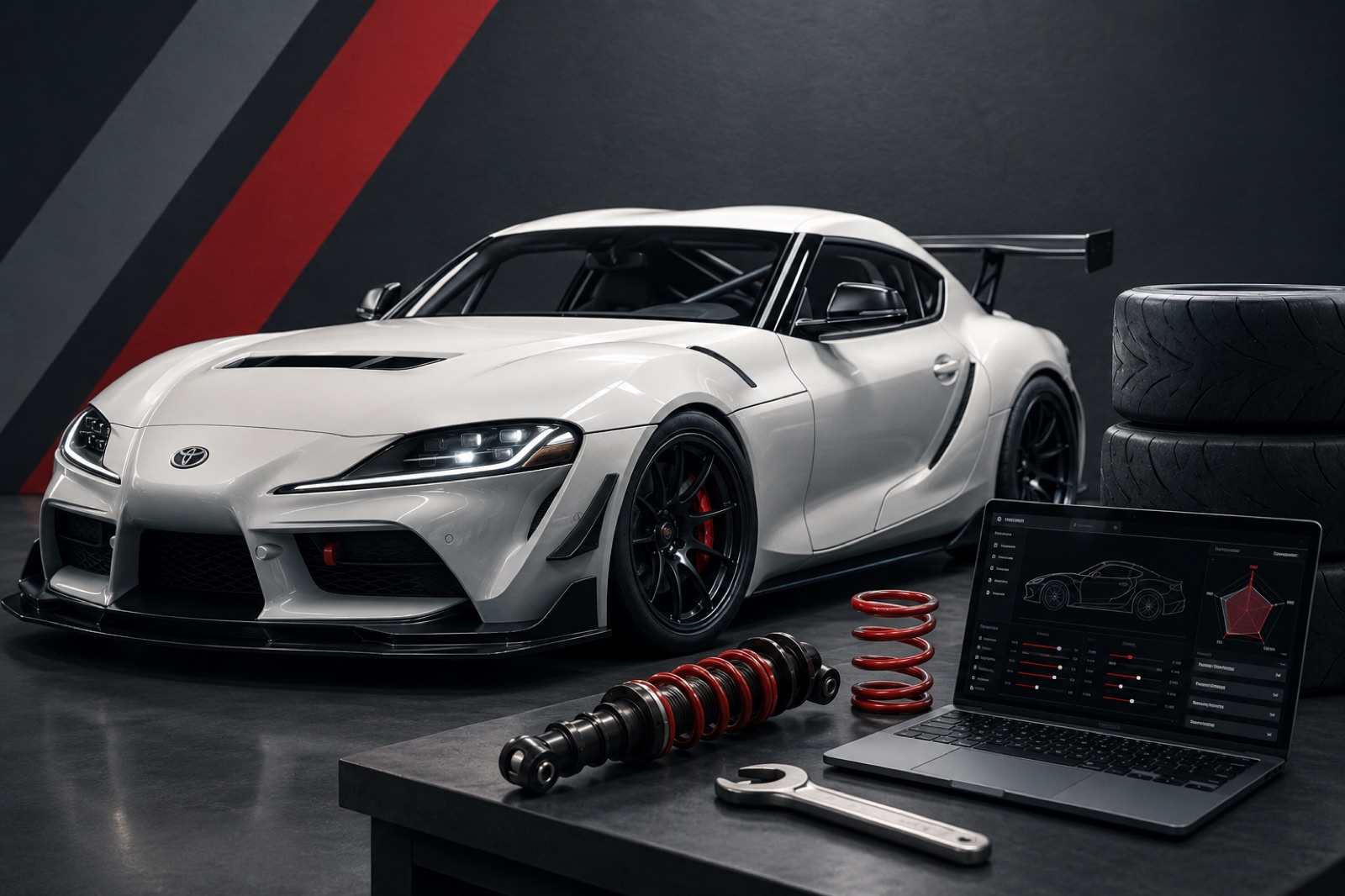
A complete baseline tune for any car in GT7. It works for road cars, race cars, engine-swapped builds, and everything in between. Values validated against in-game data.
How to use this guide
- Follow the tuning order below. Each setting builds on the one before it.
- Use the starting values in each section. Some settings (dampers, ARBs, LSD) use the same scale on every car. Others (springs, ride height) vary per car, so I give slider-position guidance instead.
- Drive 3-5 laps. Something feel wrong? Jump to the troubleshooting section.
- Make ONE change at a time. Test again. Repeat until it feels right.
Before you start: buy these parts
You need these from GT Auto to access all tuning settings:
- Fully Customizable Suspension — unlocks ride height, springs, dampers, ARBs, camber and toe.
- Fully Customizable LSD — unlocks all 3 differential parameters (scale 5-60). Often lowers PP vs other diff types.
- Fully Customizable Racing Transmission (optional) — unlocks individual gear ratios and fastest shift times.
Ranges vary per car
GT7 gives different cars different tuning ranges. For example:
| Setting | Lightweight road | Sports road | Gr.3 race |
|---|---|---|---|
| NF front | 1.20 - 3.10 Hz | 1.40 - 3.30 Hz | 3.00 - 5.00 Hz |
| Ride height front | 80 - 180 mm | 80 - 175 mm | 55 - 80 mm |
| Dampers (comp) | 20 - 40 | 20 - 40 | 20 - 40 |
| ARBs | 1 - 10 | 1 - 10 | 1 - 10 |
| LSD (all) | 5 - 60 | 5 - 60 | 5 - 60 |
Dampers, ARBs and LSD use the same scale on every car, so I give exact numbers for those. Natural frequency and ride height vary hugely, so I give slider-position guidance (e.g. "start at midpoint") that works regardless of your car's range.
Pro tip: Save your settings sheet before every change and name them descriptively. You'll want to revert when experiments fail.
The tuning order
Every setting depends on the ones before it. Work through them in this exact sequence.
| Step | Category | Why this order |
|---|---|---|
| 0 | Tires | Everything depends on grip level. Pick the compound first. |
| 1 | Downforce / aero | Sets how much load the suspension handles at speed. |
| 2 | Ride height | Establishes centre of gravity and suspension travel. |
| 3 | Natural frequency | Springs must match ride height to avoid bottoming out. |
| 4 | Anti-roll bars | Fine-tunes mid-corner balance after springs are set. |
| 5 | Dampers | Control weight-transfer speed. |
| 6 | Camber | Optimises tire contact based on final geometry. |
| 7 | Toe | Last alignment adjustment. Causes tire wear if overdone. |
| 8 | LSD / differential | Controls driven-wheel behaviour under power and braking. |
| 9 | Transmission | Track-specific gearing. Doesn't affect balance. |
| 10 | Brake balance | Adjustable mid-race, so tune it last. |
Golden rule: change one setting at a time, then drive 3-5 laps to evaluate.
1. Aerodynamics (downforce)
Downforce pushes the car into the road at speed, increasing grip without adding weight. Install aero parts (front splitter, rear wing) in GT Auto, then adjust levels in the Tuning Shop. Set this first because it determines how much load your suspension must handle.
The rear wing generates far more force than the front splitter at equal settings. Setting both to the same number produces a rear-heavy aero balance.
The three constants: your tune rests on three values the car always reverts to — weight distribution, front ride height, and downforce balance. These are your foundation.
| Car | Front downforce | Rear downforce |
|---|---|---|
| Gr.3 and Gr.4, front-engined | maximum | minimum, a few clicks up if the rear steps out at speed |
| Gr.3 and Gr.4, mid- or rear-engined | near maximum | around 40% of range, car by car |
| Road cars on racing tyres | 65-85% of range | 80-95% of range |
| Road cars on sports tyres | 30-70% by track speed | 45-85% by track speed |
The race-car line is the BoP setting: it is what esports Gr.3 teams run and what published BoP sheets show. The old advice to run more rear than front comes from PP-capped racing, where the rear wing costs fewer points per unit of grip; in a BoP race there is no PP to save, and the front wing is what buys turn-in.
The speed penalty in GT7 is often surprisingly small while the cornering gains are substantial. Positive rake (rear higher than front) can generate extra rear grip through ground effect: more rake = more rear grip at speed, but more oversteer.
Pro tip: GT7 does not punish soft springs under high downforce the way a real car does. Published race setups run the middle of the spring range with maximum front wing.
No aero parts installed? Skip this section. Your car relies on mechanical grip alone.
2. Ride height
Warning: if you lower the car too much the wheels can physically rub the wheel arches. When this happens the car refuses to turn — severe understeer no other setting can fix. If the car suddenly won't turn mid-corner, especially over bumps or curbs, raise your ride height before changing anything else.
Ride height (mm) sets how high the car sits. Lower = lower centre of gravity = less body roll = more grip. But too low and you bottom out or rub the arches. Ranges vary hugely (a road car might have 80-180 mm; a Gr.3 only 55-80 front), so use slider position, not absolute numbers.
Rake (rear sits higher than front) is your biggest handling variable here.
| Rake | Effect |
|---|---|
| Front lower than rear (positive) | Promotes rotation and oversteer. Preferred for circuit racing. |
| Front = rear (zero) | Neutral balance. Good starting point for beginners. |
Starting position: front 3-5 clicks above your car's minimum, rear 5-8 clicks above minimum. This creates positive rake. The approach is identical regardless of car class or tire compound — the car's range already accounts for the difference. Add 2-3 extra clicks on bumpy tracks (Nordschleife); flat tracks (Fuji, Daytona) can go lower.
| Change | Effect |
|---|---|
| Raise the front | Generates understeer, harder to turn in |
| Raise the rear | Generates oversteer, rear rotates more |
| Lower both equally | More grip, less body roll, risk bottoming out or arch rub |
Pro tip: lowering ride height produced the biggest lap-time improvement in community testing. Go as low as you can without arch rub. If you change ride height, re-check natural frequency.
3. Natural frequency (spring rate)
Natural frequency (Hz) controls spring stiffness. GT7's Hz system already accounts for the car's weight. The available range varies per car.
The rear offset: GT7 builds in a natural rear offset. On the same car, the rear range starts and ends higher than the front (e.g. front 1.20-3.10, rear 1.35-3.25). So if you set both sliders to the same relative position, the rear is already slightly stiffer. This is by design and promotes rotation.
| Tire compound | Front NF position | Rear NF position |
|---|---|---|
| Comfort: Hard | ~25-30% of range | Same slider position |
| Comfort: Medium | ~30-35% | Same slider position |
| Comfort: Soft | ~35-40% | Same slider position |
| Sports: Hard | ~40-45% | Same slider position |
| Sports: Medium | ~45-50% (midpoint) | Same slider position |
| Sports: Soft | ~55-60% | Same slider position |
| Racing: Hard | ~60-65% | Same slider position |
| Racing: Medium | ~65-75% | Same slider position |
| Racing: Soft | ~75-85% | Same slider position |
| Racing: Intermediate | ~40-45% | Same slider position |
| Racing: Heavy Wet | ~30-35% | Same slider position |
"Same slider position" means: if you set the front to its midpoint, set the rear to its midpoint too. The built-in offset keeps the rear naturally stiffer. Want more rotation? Move the rear 1-2 clicks stiffer relative to the front.
| Symptom | Fix |
|---|---|
| Understeer | Soften front NF or stiffen rear NF (1-2 clicks) |
| Oversteer | Stiffen front NF or soften rear NF |
| Bouncing | Springs too soft, raise NF a few clicks |
| Bottoming out | Raise NF or raise ride height |
Heavy cars (>1500 kg): 1-2 clicks stiffer. Light cars (<900 kg): 1-2 clicks softer. Bumpy tracks: 2-3 clicks softer. More downforce from Section 1: go stiffer to handle the load.
4. Anti-roll bars
ARBs resist body roll in corners. GT7 uses a 1-10 scale on all cars (higher = stiffer = flatter). ARBs only act during cornering — no effect on straight-line bumps or braking.
| Change | Effect |
|---|---|
| Stiffen front ARB | Less front grip, more understeer |
| Soften front ARB | More front grip, less understeer |
| Stiffen rear ARB | Less rear grip, more rotation / oversteer |
| Soften rear ARB | More rear grip, less oversteer |
| Drivetrain | Front | Rear | Logic |
|---|---|---|---|
| FR | 6 | 4 | Stiffer front for stability, rear free to rotate |
| FF | 4 | 6 | Stiffer rear combats natural FF understeer |
| MR / RR | 6 | 3 | Stiffer front tames entry oversteer |
| AWD | 5 | 5 | Balanced, then adjust for track |
Racing tires: add 2 to both ends. Heavy cars (>1500 kg): add 1 to both ends.
Warning: too stiff and the inside wheel lifts off in corners. Watch replays — if you see daylight under the inside tire, soften that end.
Pro tip: start understeering, then tune toward oversteer. It's easier to add rotation than remove it.
5. Dampers
Springs decide how much the car moves; dampers control how fast. Compression = how fast it squashes down (scale 20-40). Expansion/rebound = how fast it bounces back up (scale 30-50). Same scales on every car.
| Setting | Scale | Start | Notes |
|---|---|---|---|
| Front compression | 20-40 | 28-30 | Nose dive + bump absorption. Lower = better over curbs |
| Rear compression | 20-40 | 28-30 | Rear squat under accel. Too high breaks traction |
| Front expansion | 30-50 | 38-40 | How quickly the front rises. Must be higher than compression |
| Rear expansion | 30-50 | 38-40 | How quickly the rear rises. Too high = rear hops under braking |
Cardinal rule: expansion must ALWAYS be higher than compression. A starting pair of comp 30 / exp 40 puts you at midpoint for both.
| Increase this… | To reduce this… |
|---|---|
| Front compression | Entry oversteer (nose dives too fast) |
| Front expansion | Mid/exit understeer (front lifts too slowly) |
| Rear compression | Exit understeer (rear squats too much) |
| Rear expansion | Entry/mid oversteer (rear lifts too fast) |
Bumpy tracks: drop compression 2-3 clicks toward minimum. Endurance: drop all values 1-2 clicks for consistency.
Pro tip: if you stiffen springs, soften dampers slightly. Stiff springs + stiff dampers = the car hops over bumps.
6. Camber
Negative camber means the top of the wheel leans inward. In corners, body roll pushes the outside wheel outward; camber compensates, keeping the tire flat at the apex. In GT7, front camber mainly affects mid-corner grip rather than initial turn-in.
| Tire compound | Front camber | Rear camber |
|---|---|---|
| Any (comfort, sports, racing, wet) | 3.0° | 3.0° |
| Front-wheel drive, any tyre | 3.0° | 2.0° |
Three degrees each end is where published setups land on every tyre and every class: across 925 sheets read in September 2026 the median was 3.0 front and 3.0 rear on racing, sports and comfort tyres alike, with the same split whatever the car's weight balance, and the same figure in the wet. Front-drive cars run less at the rear so it can rotate. Stiffer springs do not call for less camber, and endurance races do not either.
Pro tip: more body roll (softer springs/ARBs) = increase camber. Less roll = you can reduce it.
7. Toe angles
Toe = whether wheels point inward (toe-in, positive) or outward (toe-out, negative). Any deviation from zero causes tire scrub. Toe is the last alignment adjustment and changes should be tiny.
| Setting | Value | What it does |
|---|---|---|
| Front toe | 0.00° (neutral) | Toe-out sharpens turn-in but adds wear. Start neutral. |
| Rear toe | +0.05° (slight toe-in) | Stabilises the rear in straight lines. |
Short wheelbase (Mini, Fiat 500, Copen): increase rear to +0.08 or +0.10°. Long wheelbase (NSX, LFA): +0.03°. Endurance: minimise toe toward zero.
Warning: don't use toe to fix handling problems that springs, ARBs or LSD should fix. Toe is a scalpel, not a sledgehammer.
8. LSD (limited slip differential)
The LSD controls power sharing between the left and right driven wheels. All three parameters use a 5-60 scale on every car. Higher values lock the wheels together (stability, traction); lower values let them spin independently (rotation, agility). You must buy the Fully Customizable LSD from GT Auto.
- Initial torque (5-60): always-on locking force. Low (5-10) = snappy transitions. High (15+) = smooth but adds understeer. Start at 5.
- Acceleration sensitivity (5-60): wheel locking under throttle. Your corner-exit knob. Higher = more traction, less rotation.
- Braking sensitivity (5-60): wheel locking under braking/coasting. Your corner-entry knob. Higher = stable entry, more understeer.
| Drivetrain | Init. torque | Accel | Braking | Notes |
|---|---|---|---|---|
| FR | 5 | 10-15 | 25 | Gr.3 sits at 5 / 10 / 25, Gr.4 at 5 / 15 / 25 |
| FF | 5-15 | 25-40 | 5-10 | High accel prevents inside-wheel spin |
| MR | 8 | 15 | 35-45 | Low accel avoids snap, high braking stabilises entry |
| RR | 10 | 20 | 45 | Like MR with a touch more everywhere |
AWD: Front LSD 5-7 / 5-15 / 5-10, Rear LSD 5-11 / 15-25 / 5-14, centre split 30% front / 70% rear. Keep the front LSD open (low) to preserve turn-in; the rear handles traction.
Pro tip: tune suspension first, then LSD. Get the car balanced mechanically before touching the diff. Setting everything to maximum creates massive understeer and dangerous snap oversteer — adjust 2-5 points at a time.
9. Transmission
- Set Final Drive all the way RIGHT (shortest ratio).
- Move Top Speed slider all the way LEFT (lowest speed).
- Move 1st gear all the way LEFT (longest ratio, prevents wheelspin).
- Space the remaining gears evenly, getting closer together at the top end.
- Back out and adjust Final Drive LEFT until you reach your desired top speed.
- Test: hit redline at the end of the longest straight, just before braking.
Warning: changing the Top Speed slider RESETS all individual gear adjustments. Always set top speed BEFORE touching individual gears.
Lower gears (1st-3rd): wide spacing for acceleration. Upper gears (4th-6th+): closer together to stay in the power band. Final drive influences engine braking: higher = more engine brake (tight tracks), lower = less (flowing tracks).
10. Brake balance
Determines front vs rear braking force. GT7 defaults to a slight front bias.
| Drivetrain | Adjustment | Why |
|---|---|---|
| FR | Default or 1 click rear | Improves trail-braking rotation |
| FF | 1-2 clicks rear | Frees front tires for steering while braking |
| MR / RR | 1 click front | Prevents rear locking under braking |
| AWD | Default | Generally balanced as-is |
Pro tip: brake balance is adjustable mid-race via the MFD. Shift it rearward as the front tires wear.
Troubleshooting quick reference
Diagnose using the 3 W's: what is happening, where on the corner (entry / apex / exit), and when during your inputs (braking / coasting / throttle)?
Car understeers (won't turn in)
- Soften front ARB or stiffen rear ARB
- Soften front NF by 1-2 clicks
- Increase front camber by 0.5°
- Increase front downforce / reduce rear
- Move brake balance rearward
- Reduce LSD initial torque
Car oversteers (rear slides out)
- Stiffen front ARB or soften rear ARB
- Soften rear NF by 1-2 clicks
- Increase rear downforce
- Reduce LSD accel sensitivity by 5
- Add rear toe-in (+0.05°)
- Move brake balance forward
Too stiff / bouncy
- Reduce NF 2-3 clicks both ends
- Reduce compression damping toward 24-26
- Soften ARBs by 1-2
- Raise ride height 2-3 clicks
Too soft / wallowy
- Increase NF 2-3 clicks both ends
- Stiffen ARBs by 1-2
- Increase compression damping toward 34-36
- Lower ride height 2-3 clicks
Unstable under braking
- Move brake balance forward
- Increase LSD braking sensitivity by 5
- Add rear toe-in (+0.05°)
- Increase rear expansion toward 42-44
- Reduce rake (equalise ride heights)
Losing traction on corner exit
- Check tire indicators: inside spinning = increase LSD accel, outside = decrease
- Soften rear springs 1-2 clicks
- Lower rear compression toward 26-28
- Lengthen lower gear ratios
- Increase traction control by 1-2
Poor straight-line stability
- Add rear toe-in (+0.05 to +0.10°)
- Remove front toe-out (set to 0.00°)
- Increase rear downforce
- Reduce excessive negative camber
Excessive tire wear
- Reduce toe toward neutral on both ends
- Reduce camber on the wearing end by 0.3°
- Soften ARBs on the wearing end
- Reduce LSD accel sensitivity by 5 (rear wear)
- Shift brake balance away from the wearing end
Car bottoms out
- Raise ride height 2-3 clicks on the affected end
- Stiffen NF 2-3 clicks
- Increase compression toward 34-36
- Reduce downforce if very high
Car hops over curbs
- Lower compression toward 24-26
- Lower expansion toward 34-36
- Soften ARBs by 1-2
- Raise ride height 1-2 clicks
Master baseline values
These work across all car types. Print them and keep them next to your TV.
Universal settings (same scale on every car)
| Setting | Scale | Starting value |
|---|---|---|
| Front compression | 20-40 | 30 (midpoint) |
| Rear compression | 20-40 | 30 (midpoint) |
| Front expansion | 30-50 | 40 (midpoint) |
| Rear expansion | 30-50 | 40 (midpoint) |
| Front ARB | 1-10 | 4-6 (depends on drivetrain) |
| Rear ARB | 1-10 | 3-6 (depends on drivetrain) |
| Front camber | varies | -1.5 to -2.0° (Sports tires) |
| Rear camber | varies | -1.0 to -1.5° (Sports tires) |
| Front toe | varies | 0.00° (neutral) |
| Rear toe | varies | +0.05° (slight toe-in) |
Per-car settings (use slider position)
| Setting | Starting position |
|---|---|
| Natural frequency (front) | Sports tires: midpoint. Racing tires: 70-80% of range |
| Natural frequency (rear) | Same slider position as front |
| Ride height (front) | 3-5 clicks above minimum |
| Ride height (rear) | 5-8 clicks above minimum (positive rake) |
LSD by drivetrain (scale 5-60 on all cars)
| Layout | Init. torque | Accel | Braking |
|---|---|---|---|
| FR | 5 | 25 | 10 |
| FF | 10 | 35 | 8 |
| MR | 5 | 15 | 20 |
| RR | 5 | 15 | 25 |
| AWD front | 5 | 10 | 5 |
| AWD rear | 8 | 20 | 10 |
| AWD centre | 30/70 |
GT7 tips every beginner should know
- Tires need warm-up laps. Racing tires are slow when cold. Wait 2 laps before judging your tune.
- Permanent mods are permanent. Weight reduction and body rigidity can't be removed. Keep a duplicate car.
- ECU vs power restrictor. ECU reduces power evenly (preserves the curve). The restrictor kills top end but keeps low-end punch for exits.
- Wheel-arch rubbing kills turn-in. If the car suddenly won't turn mid-corner, ride height is too low. Raise it first.
- PP uses AI simulation. PP doesn't always match real performance. Trust your lap times, not the number.
- Controller vs wheel doesn't change the tune. Core suspension and diff values are identical. Wheel users may reduce assists.
- Fully Customizable LSD can lower PP. Vs other diff types it sometimes costs fewer PP points. Free performance.
- Tuning ranges vary per car. Use slider positions, not absolute numbers, when following guides online.
- Save settings constantly and name them descriptively. You'll break things and need to revert.
Glossary
| Term | What it means |
|---|---|
| Natural frequency (Hz) | How stiff your springs are. Higher = stiffer. Range varies per car |
| Ride height (mm) | How high the car sits. Range varies per car |
| Rake | Rear higher than front. More = more rotation |
| Anti-roll bar (1-10) | Stops leaning in corners. Higher = flatter |
| Compression damper (20-40) | How fast suspension squashes down |
| Expansion / rebound (30-50) | How fast it bounces back up |
| Camber (deg) | Wheel lean. More negative = more mid-corner grip |
| Toe-in / toe-out (deg) | Wheels point inward (stability) or outward (turn-in) |
| LSD (5-60) | Power sharing between left/right driven wheels |
| Initial torque | The LSD's always-on locking force |
| Accel sensitivity | How much the wheels lock under throttle |
| Braking sensitivity | How much the wheels lock under braking |
| Understeer | Car pushes wide, won't turn enough |
| Oversteer | Rear slides out, car turns too much |
| Contact patch | Part of the tire touching the road |
| Downforce | Force pushing the car down at speed |
| PP | GT7's speed rating for race restrictions |
| Trail braking | Braking while turning in (advanced technique) |
| Venturi / ground effect | Air suction under the car pulls it down |
Free resource for the GT7 community. Share freely. v1.2 — values validated against in-game data, cross-referenced with FILO Engineering, DG EDGE, Coach Dave Academy and GTPlanet. Corrections welcome.