
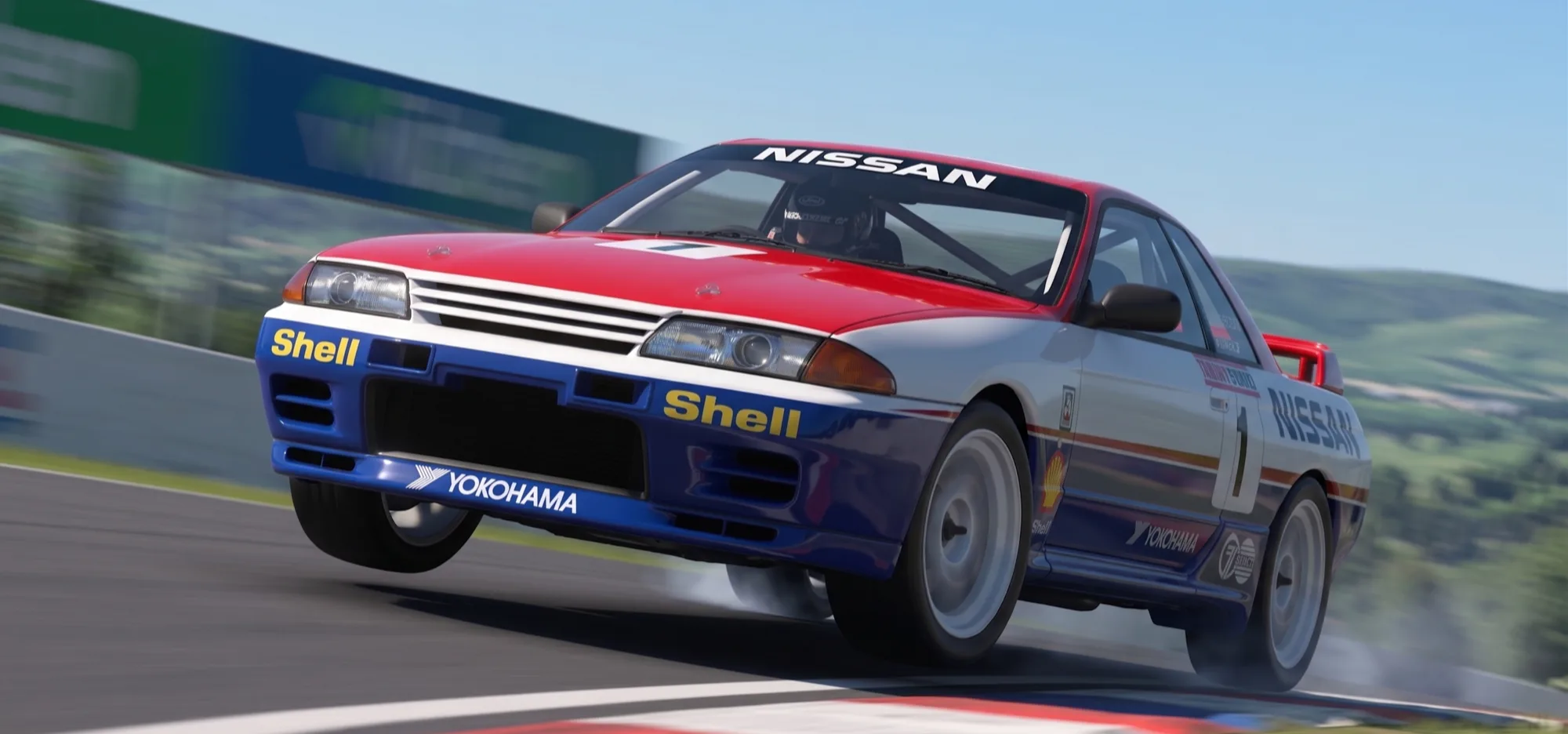
The car they banned from Bathurst. We rebuilt the Group A R32 GT-R in GT7, restricted it to the 625hp Gibson Motorsport ran, and raced it at Mount Panorama against the cars it beat in 1991.
Overview
In 1991 and 1992, Fred Gibson's Nissan Skyline R32 GT-R won Bathurst twice. The officials added weight. They restricted the boost. It kept winning. So they banned turbocharging and all-wheel drive entirely. The R32 wasn't outlawed by name. They just banned everything that made it fast.
The GT7 car is the NISMO '90, the actual homologation model. Nissan built 500 road cars and 60 race cars to satisfy the FIA's Group A requirements. It costs around 397,700 credits from Used Cars and weighs 1,400 kg stock. That's the exact minimum weight CAMS forced the car to carry at Bathurst in 1992. It comes out of the showroom at its punishment weight.
Fully built, GT7 lets the RB26 make over 800hp. Gibson's team made 625. So we set the power restrictor to 71% and held it there. The boss of Nismo called Gibson and told him his cars were too quick. They wouldn't let him race in Japan.
The setup
Fully built engine, transmission, suspension, brakes, body rigidity. No weight reduction: the car stays at its 1,400kg punishment weight, and the power comes back down to 625 hp to match the Gibson Motorsport Group A specification.
Bathurst tune (Racing Medium)
- Tyres: Racing Medium front and rear
- Downforce: 0 / 30
- Transmission: Fully Customisable Racing, top speed 300 km/h
- Suspension: ride height 100/110 · ARB 6/8 · damping comp 28/28, exp 40/40 · nat. freq 2.90/3.15 · camber 2.0/1.7 · toe 0.03 out / 0.07 in
- Differential: Fully Customisable · front torque 5 / accel 10 / braking 30 · rear torque 10 / accel 30 / braking 20 · centre: Torque-Vectoring 35:65 front/rear
- ECU: 100 · Power Restrictor: 71% · Ballast: 0
The 35:65 rear-biased torque split mirrors Gibson's ATTESA mode 1 racing setup. The real car was rear-biased with the front axle engaging under slip. Front downforce is zero because the Group A car ran minimal aero. Rear at 30 keeps the car planted through the Mountain without adding drag on Conrod Straight.
Build your own in the Tuning Assistant
On track
We built a custom race at Mount Panorama against GT Sophy AI. The grid: Ford Sierra RS500 Cosworths tuned to 415hp at under 1,000kg, and BMW M3 Sport Evolutions at 360hp and 983kg. Both RWD. Three R32 GT-Rs on the grid including ours, matching the real 1991 entry.
The R32 ate them. Started from the back, finished P1. All three GT-Rs swept the podium ahead of every Sierra and every M3. Best lap was a 2:07, which is about 7 seconds faster than Skaife's 2:14.50 race lap record from 1991. That's GT7 physics, not reality. The dominance is the part GT7 got right.
Verdict
The R32 GT-R won Bathurst twice, carrying more weight than anything else on the grid, with restricted boost, against cars with 30 years of development behind them. They couldn't beat it. So they changed the rules.
In GT7, with the power held at 625hp and the weight at 1,400kg, the result was the same. Three GT-Rs on the podium. Every rear-drive car behind them. 35 years later, Godzilla still does what Godzilla does.